Why Airtightness Is Now Critical Under NCC 2022
The National Construction Code (NCC) 2022 Section J has fundamentally shifted how energy efficiency is achieved in Australian buildings.
It is no longer enough to rely on insulation alone.
Uncontrolled air leakage is now one of the biggest threats to compliance.
For architects, engineers, and developers, this means:
- Higher performance expectations
- Greater scrutiny on building envelopes
- Increased reliance on airtightness strategies and validation
If your building leaks air, it leaks energy and that directly impacts your ability to meet NCC compliance.
The New Focus: Part J1P1 and Controlling Infiltration
The primary objective of Section J remains reducing operational energy consumption. However, NCC 2022 recognizes that air leakage (infiltration) is a massive source of thermal loss in Australian commercial buildings.
Under
Part J1P1 (Performance Requirement), the building envelope must now be constructed to be “appropriately airtight.” This is defined by a mandatory air permeability rate:
- Maximum 5 m3/(h·m2) at 50 Pa reference pressure.
This metric quantifies the amount of air escaping through the building envelope per hour, normalized by the surface area of the envelope. Meeting this target is essential for reducing the energy required for both heating and cooling.
Deemed-to-Satisfy Sealing Requirements (J5D7)
Before physical testing is even considered, the DTS pathway specifies non-negotiable construction details that must be implemented during the build process. These are the prescriptive measures detailed in Part J5D7:
- Windows and Doors: Must be fitted with durable seals to the head, jambs, and sills (brush or bulb seals).
- Chimneys and Flues: Must include close-fitting dampers or flaps.
- Exhaust Fans: Must be fitted with self-closing dampers.
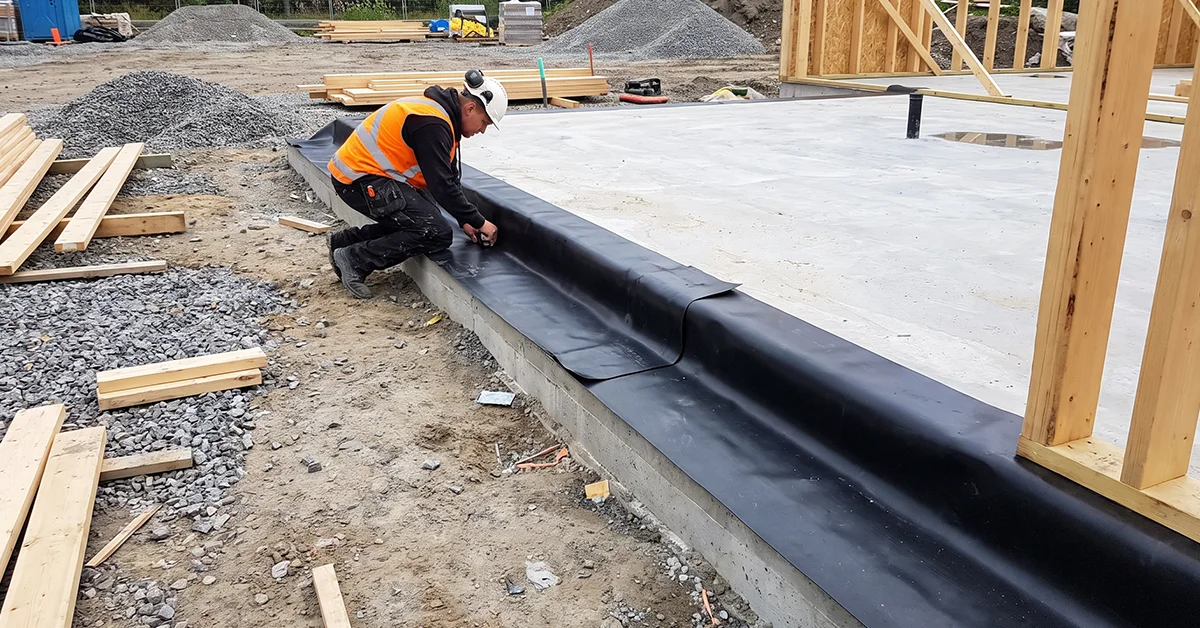
- Fabric Junctions: All connections between roofs, walls, and floors – plus all penetrations for services (pipes, cables, ducts) – must be meticulously sealed using membranes, tapes, or durable sealants.
The Compliance Pathways: Testing vs. Verification
To prove that a building meets the mandated 5 m3/(h·m2) threshold, designers must choose one of two compliance routes:
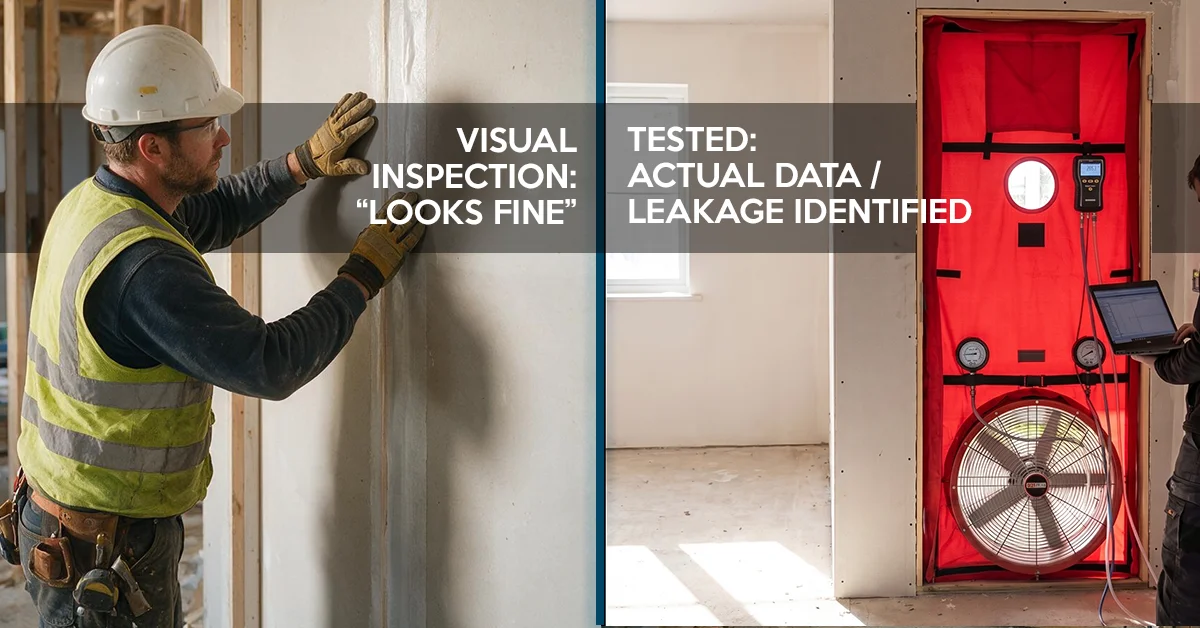
1. The Verification Method (JV4) – The Blower Door Test
This is the most robust way to ensure compliance and is increasingly preferred for complex designs.
- The Standard: Testing must be conducted strictly in accordance with AS/NZS ISO 9972.
- The Process: Large, calibrated fans are mounted in a main doorway to pressurize and depressurize the entire building (or representative zones).
- The Benefit: A successful JV4 test provides definitive performance data. This often allows designers to use holistic energy modeling to offset other design elements (like standard-performance glazing) with the building’s superior airtightness.
2. The DTS Pathway – Evidence of Suitability
If a formal blower door test is not conducted, the builder must provide comprehensive “Evidence of suitability” to the building certifier.
This requires a rigorous inspection and documentation regime throughout construction, proving that every prescriptive requirement of Part J5D7 has been met and that all fabric junctions are continuously sealed.
This requires meticulous documentation of prescriptive sealing measures, including:
- Windows and Doors: Durable seals (brush or bulb) to the head, jambs, and sills.
- Fabric Junctions: Continuous sealing of connections between roofs, walls, and floors using membranes or tapes.
- Openings: Self-closing dampers on exhaust fans and close-fitting flaps on chimneys.
Typical Airtightness Benchmarks
Across Australia, common targets include:
- Standard commercial: 10–15 ACH@50Pa
- High-performance buildings: 5–10 ACH@50Pa
- Net Zero / Passive House: <5 ACH@50Pa
The tighter the building, the lower the energy demand and the easier compliance becomes.
Work With Specialists Who Understand Performance
At Aerotight, we work alongside architects, builders, and developers to deliver customised window furnishing solutions that actively support energy efficiency outcomes.
We don’t just supply blinds or curtains—we help improve:
- Thermal performance
- Occupant comfort
- Overall building efficiency
Particularly for projects targeting:
- NCC 2022 compliance
- NABERS ratings
High-performance residential and commercial builds